Pay with Crypto: Receive FREE product and 5% discount code: CRYPTO5
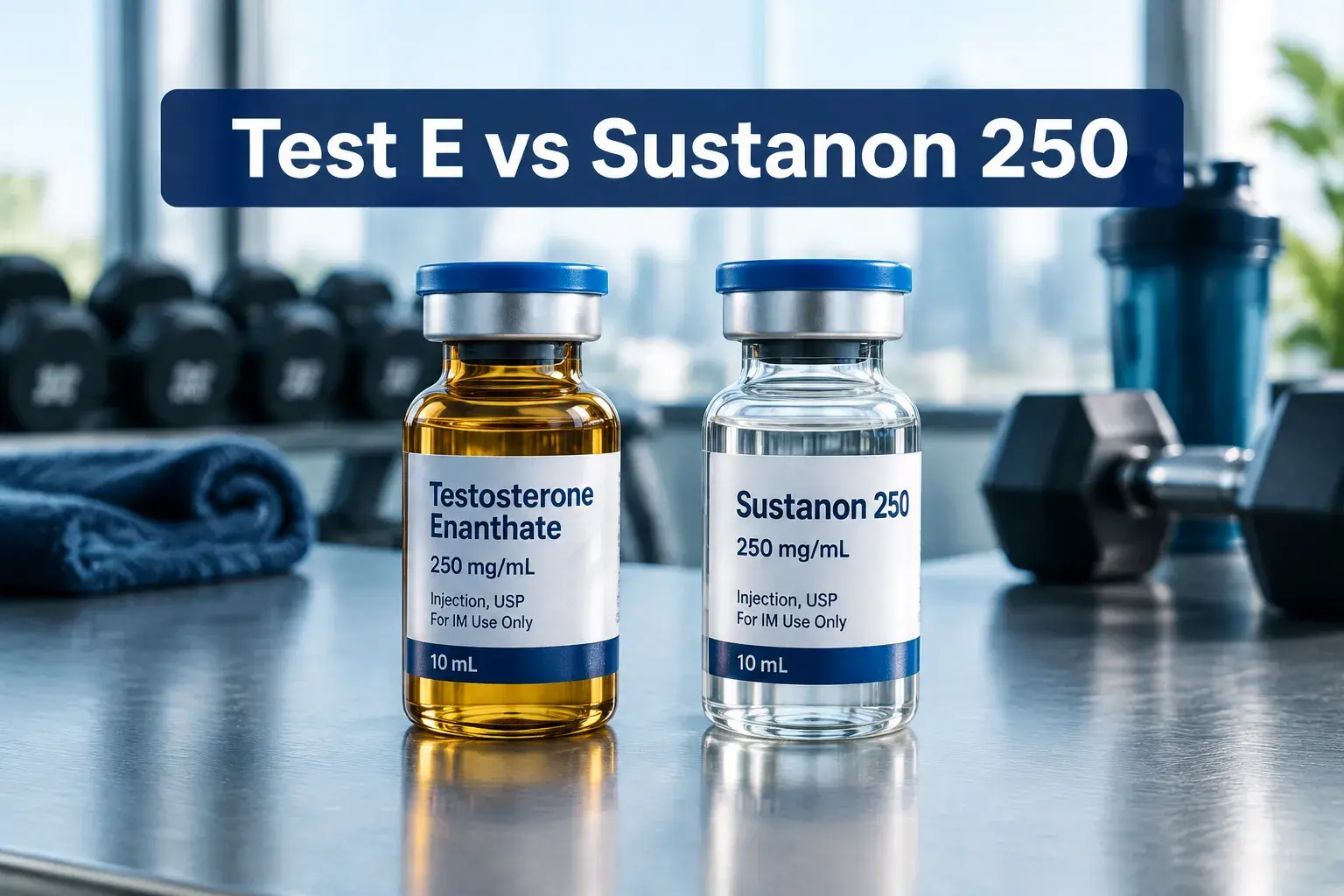

In the test e vs sust 250 debate, both deliver the same hormone and comparable muscle gains at equal doses; Test E wins on stability and simplicity, while Sustanon offers quicker onset if injected frequently enough.
Key Takeaways
Same hormone, different delivery. Both compounds release testosterone; the ester blend only changes how fast and how smoothly it enters your blood.
Test E half-life is ~7 days; Sustanon's four esters range from ~1 day (propionate) to ~15 days (decanoate).
Sustanon kicks in faster subjectively (often within the first week), but Test E produces more stable serum levels.
Muscle and strength gains are effectively identical milligram for milligram once blood levels are matched.
Sustanon causes more hormonal fluctuation if injected only once weekly, which can mean more mood swings, acne, and estrogen spikes.
Test E is generally the better beginner choice because stable levels make side effects easier to read and manage.
Neither is "better for cutting" chemically, water retention depends on dose, diet, and estrogen control, not the ester blend itself.
⚠️ Important: This article is educational and harm-reduction focused, not an endorsement.
What's the Difference Between Test E and Sustanon 250?
The core difference is simple: Test E contains one ester, Sustanon 250 contains four. Testosterone Enanthate is testosterone attached to a single enanthate ester, usually dosed at 250mg/ml. Sustanon 250 is a blend of testosterone propionate (30mg), phenylpropionate (60mg), isocaproate (60mg), and decanoate (100mg) per ml, as detailed in the official UK patient information leaflet for Sustanon 250.
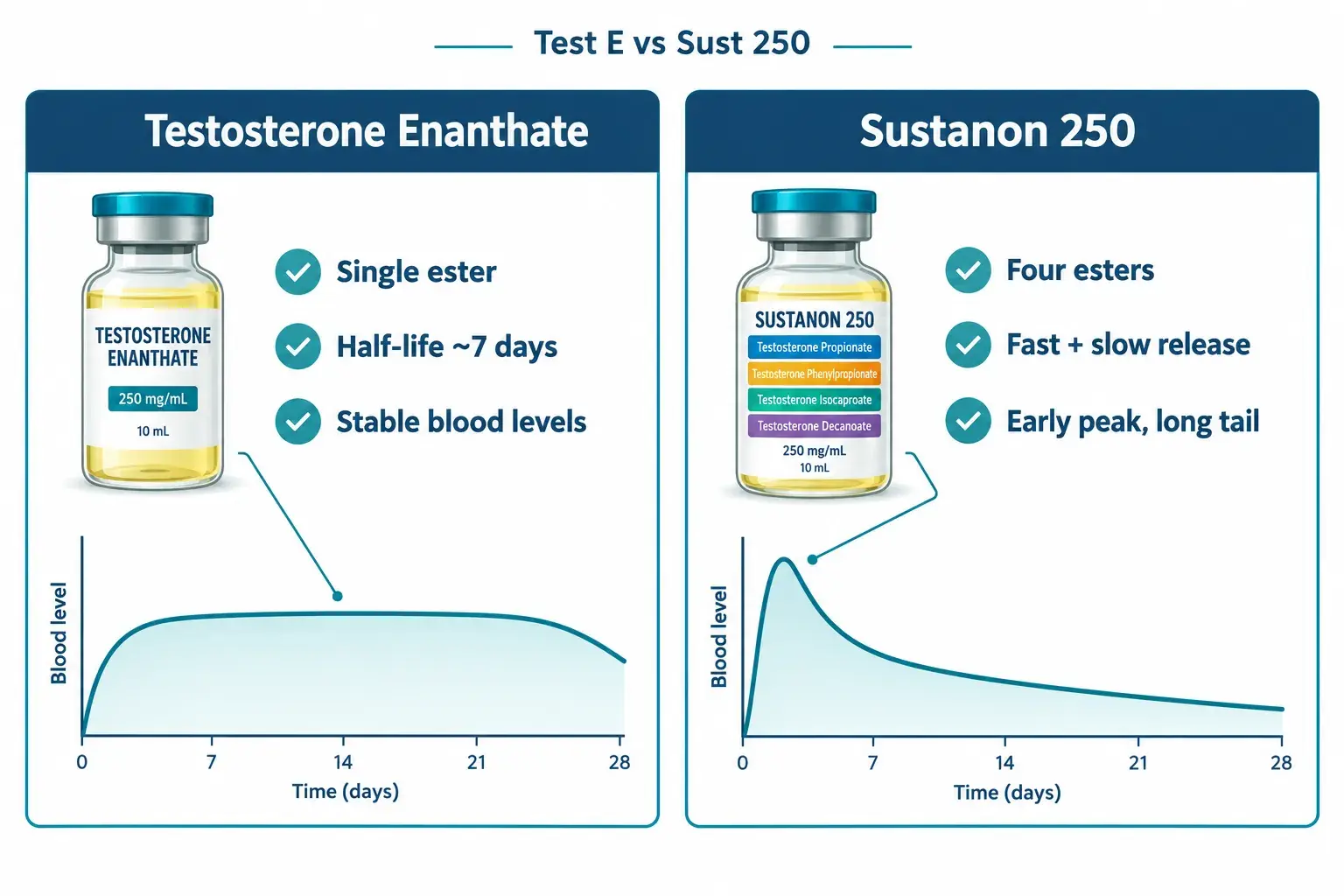
Here's the part many lifters miss: because esters add weight, the actual testosterone payload is nearly identical. 250mg of Test E yields roughly 175-180mg of pure testosterone, and Sustanon 250 delivers a similar ~176mg.
Quick decision rule: if you want predictable, easy-to-manage blood levels, choose Test E. If you want a faster initial kick and don't mind more frequent pinning, Sustanon fits.
What Is Testosterone Enanthate?
Test E is a long-acting injectable testosterone used medically for testosterone replacement therapy (TRT) for decades. In bodybuilding, it's the default "base" testosterone for most cycles because its ~7-day half-life makes blood levels easy to keep steady.
What Is Sustanon 250?
Sustanon 250 is Organon's four-ester testosterone blend, originally designed so TRT patients could inject less often, the short esters provide immediate testosterone while the long decanoate ester sustains release for weeks. The UK prescribing leaflet lists a clinical dosing interval of one injection every three weeks. Bodybuilders, however, use it very differently (more on that below).
How Do They Work? Test E Half-Life Compared to Sustanon
Test E has one clean half-life of about 7 days; Sustanon has four overlapping half-lives, from roughly 1 day to about 15 days. Once injected into muscle, enzymes cleave the ester off, releasing free testosterone into the bloodstream at a rate determined by the ester's length.
Factor | Testosterone Enanthate | Sustanon 250 |
|---|---|---|
Esters | Enanthate only | Propionate, phenylpropionate, isocaproate, decanoate |
Half-life | ~7 days | ~1 to ~15 days (blended) |
Actual testosterone per 250mg | ~175-180mg | ~176mg |
Time to subjective effects | ~2-4 weeks | ~1-2 weeks |
Blood level stability | High | Moderate (fluctuates on infrequent injections) |
Typical bodybuilding injection frequency | 1-2x per week | 2-3x per week (EOD ideal) |
Best suited for | Beginners, TRT, steady cycles | Users wanting fast onset who tolerate frequent pins |
Sustanon 250 Peak Levels vs Test Enanthate
Sustanon produces an early peak within 24-48 hours from the propionate fraction, then a declining plateau carried by the longer esters. Test E peaks more gradually, around 2-3 days post-injection, then declines smoothly over the week. Test E injected twice weekly holds serum testosterone within a much tighter band, while once-weekly Sustanon creates a noticeable spike-and-trough pattern. Tighter bands generally mean fewer estrogen-related side effects and steadier mood and libido.
How Long Does Test E Take to Kick In vs Sustanon?
Sustanon is felt sooner, often within 4-7 days, thanks to its short propionate and phenylpropionate esters, while Test E typically takes 2-4 weeks before strength, libido, and pump improvements become obvious. Full "cruising altitude" blood saturation takes 4-5 weeks for both compounds.
What lifters usually report:
Week 1: Sustanon users notice improved libido, aggression in the gym, and better recovery. Test E users notice little.
Weeks 2-3: Test E begins to show; Sustanon users are already seeing scale weight climb.
Weeks 4-6: Both compounds are fully saturated. From here, the experience is essentially identical.
Edge case: if your cycle is short (8 weeks or less), Sustanon's faster onset genuinely matters. On a standard 12-16 week cycle, the 1-2 week head start becomes irrelevant by the halfway point.
Which Is Better for Muscle Gain and Strength: Test E or Sust 250?
Neither builds more muscle than the other at equal doses, the anabolic effect comes from serum testosterone, and both deliver essentially the same payload. A 500mg/week cycle of either compound over 12-16 weeks produces comparable lean mass gains, with real-world results depending far more on training, food, and genetics than ester choice.
For strength specifically, the picture is the same: strength tracks total androgen exposure. Our bulking comparison concludes that for bulking, the choice between Test E and Sustanon comes down to injection preference and availability rather than any meaningful difference in results.
Typical bodybuilding doses (for context, not recommendation):
First cycle: 300-500mg/week for 12-16 weeks
Intermediate: 500-750mg/week
TRT/cruise: 100-200mg/week (Test E) or clinical Sustanon protocols
Common mistake: switching compounds mid-cycle expecting "better gains." You'll only reset your blood level curve and potentially introduce fluctuation side effects with zero anabolic benefit.
Sustanon 250 vs Test E for Cutting Cycles, Aromatization, and Water Retention
For cutting, Test E has a slight practical edge because stable blood levels make estrogen (and therefore water retention) easier to control. Chemically, both aromatize at the same rate, aromatization depends on how much free testosterone is circulating, not which ester delivered it.
Does Test E Aromatize More Than Sustanon?
No. Milligram for milligram, aromatization is equivalent. Sustanon's early propionate spike can cause sharper short-term estrogen surges when injections are spaced too far apart, which some users misread as "Sustanon aromatizes more."
Test E vs Sust 250 Water Retention: Which Is Worse?
Water retention is a function of estradiol levels, sodium intake, and total dose, not the brand on the vial. That said, once-weekly Sustanon users often report more visible bloat fluctuation because their estrogen rises and falls with each spike. Inject Sustanon every other day, and the difference disappears.
Decision rule for cutting: choose Test E (or Sustanon pinned EOD) with a sensible aromatase-inhibitor plan guided by blood work. Never dose an AI blind.
Sustanon 250 Side Effects vs Test E: What's Different?
The side-effect profiles are nearly identical because the active hormone is the same; the differences come from blood level stability and injection experience. Both suppress natural testosterone production, can raise estradiol, thicken blood (elevated haematocrit), worsen cholesterol, and trigger acne or accelerated hair loss in genetically prone men.

Where they differ in practice:
Fluctuation effects (Sustanon disadvantage): mood swings, libido dips, and acne flares are more common when Sustanon is injected only weekly, due to the spike-and-trough pattern.
PIP (post-injection pain): Sustanon's propionate content makes injections sting more for some users; Test E is generally smoother.
Predictability (Test E advantage): if side effects appear on Test E, blood work at any consistent time point gives a clean picture. Sustanon blood work varies heavily depending on which day post-injection you test.
Medical warnings apply to both: the Sustanon patient leaflet lists polycythaemia, blood pressure increases, and prostate monitoring requirements, all equally relevant to Test E.
Is Sustanon 250 Better for Beginners or Test E?
Test E is the better beginner choice, and this is one of the few points with near-universal agreement across comparison reviews:
Simpler pinning: two injections weekly maintains stable levels; beginners struggle enough with injection technique without an EOD schedule.
Readable blood work: a single ester means labs are interpretable, so a first-time user can actually learn how their body responds.
Smoother side-effect management: stable levels mean estrogen problems build gradually and predictably rather than spiking.
Common Mistakes When Switching From Test E to Sustanon
The biggest mistake is keeping a once-weekly injection schedule after switching, which turns Sustanon's blended release into a rollercoaster of spikes and troughs. Other frequent errors:
Ignoring the overlap period. Test E's 7-day half-life means it's still active for 2-3 weeks after your last injection. Stacking full-dose Sustanon on top immediately doubles your effective dose temporarily.
Testing blood at random times. With Sustanon, always test the same number of days after injection, or results are meaningless.
Misjudging AI needs. Estrogen management dialled in on Test E may need adjusting for Sustanon's early peaks.
Assuming faster gains. Same hormone, same gains, switching mid-cycle only adds variables.
Miscounting PCT timing. Sustanon's decanoate ester lingers: post-cycle therapy typically starts ~3 weeks after the last Sustanon injection versus ~2 weeks after Test E. Starting PCT too early wastes it against still-circulating exogenous testosterone.
Which Is Worth Taking, and What Should You Expect?
Test E is the more practical choice: cheaper, smoother, easier to dose, and simpler to manage. Sustanon earns its place when you can verify genuine sustanon 250 product, want faster onset, and are disciplined enough to inject every other day.
What to expect on a first testosterone cycle (either compound), assuming solid training and diet:
Weeks 1-4: gradual strength increases, improved recovery, rising libido (sooner with Sustanon).
Weeks 5-10: the productive window, noticeable size, fullness, strength PRs, some water weight.
Weeks 11-16: gains slow but continue; side effects (acne, blood pressure, mood) need monitoring via blood work.
Post-cycle: expect to lose some water weight; natural testosterone recovery takes weeks to months, which is why proper PCT and pre/post blood panels matter.
FAQ
Is Sustanon 250 stronger than Test E?
No. Both deliver roughly 176mg of actual testosterone per 250mg dose. Strength of effect depends on total weekly dose, not the ester blend.
How often should I inject Sustanon 250 for bodybuilding?
Every other day is ideal to keep blood levels stable; twice weekly is the practical minimum. The clinical 3-week interval produces unstable levels at bodybuilding doses.
How often should Test E be injected?
Twice weekly (e.g., Monday/Thursday) keeps levels very stable. Once weekly works but produces slightly larger fluctuations.
Which kicks in faster, Test E or Sustanon?
Sustanon, by about 1-2 weeks, thanks to its short propionate ester. Full saturation for both takes 4-5 weeks.
Can I mix Test E and Sustanon in one cycle?
Yes, since both are testosterone, but there's no benefit, and it complicates blood work interpretation. Pick one.
Which causes more water retention?
Neither, inherently. Water retention follows estradiol levels and diet. Sustanon may cause more visible fluctuation if injected infrequently.
When does PCT start after each compound?
Roughly 2 weeks after the last Test E injection and about 3 weeks after the last Sustanon injection, due to the long decanoate ester.
Which is better for TRT?
Both are used clinically. Test E's predictable single ester makes dose titration simpler, which is why many UK clinics prefer enanthate or cypionate.
Does Sustanon hurt more to inject?
Often, yes. The propionate fraction causes more post-injection pain for sensitive users compared with smooth-injecting Test E.
Conclusion
The test e vs sust 250 question has a clear answer for most people: they build the same muscle, and Test E does it with less hassle. Its single ester delivers stable blood levels, simple twice-weekly injections, cheaper prices, and blood work you can actually interpret. Sustanon 250's four-ester blend is clever pharmacology, but its advantages, faster onset, long clinical dosing intervals, matter more for TRT patients than bodybuilders, who end up injecting it every other day anyway to smooth out the curve.